

Threshold, Not Depth
What Attention Cannot Reach.

Spend enough time with someone you love and a strange thing happens. You learn them — their habits, the weight of their silences, the way their face changes before an answer. You learn them well enough that you can finish their sentences, predict their hesitations, recognise them by footstep alone. The strangeness, when it arrives, does not arrive at the beginning of the acquaintance, when one has not yet had time to know — that would not be strange at all. It arrives precisely at the height of intimacy, after years of attention have been paid, when one has every reason to believe that what was once foreign has become familiar. And yet, at some unannounced moment, one finds that one does not know them. Not in the way one had been assuming. Something stands behind everything that has been observed, and it has not been touched by any of the observing.
What, then, is one to do with such a finding?
The first response is the obvious one. Attend more carefully. Spend more time. Watch more closely. The assumption is that opacity is a function of insufficient observation, and that with enough patience and discipline the residue will dissolve into knowledge. This is how we treat almost every other domain. Misunderstand a text, read it again. Misjudge a situation, gather more facts. Fail to grasp a process, study it longer. The same logic, transposed onto persons, suggests that whatever remains hidden in another will yield to enough sustained attention.
But this fails, and it fails in a particular way. The mystic who contemplates for decades does not, at the end, possess his subject as data. The parent who attends to a child across an entire lifetime does not, at the end, find the child fully transparent. The friend of forty years does not arrive at a point where there is nothing further to encounter. The opacity does not thin with time. If anything, it deepens — not because new information has been added to the unknown column, but because what was always present becomes harder to mistake for something else. Whatever is in question here, it does not behave like missing data. Missing data, given enough attention, gives way. This does not.
The second move is to suppose that the person hides. There is psychological defence, there are blind spots, there is the simple fact that no one offers themselves whole. Open the person up — through trust, through love, through the slow erosion of their guarded places — and the residue will dissolve. But this also fails. Even in moments of total transparency, even between two people who have nothing left to conceal, the irreducibility remains. It is not produced by withholding. It is not abolished by disclosure. Whatever it is, it is not on the same axis as concealment and revelation.
There remains a place where the difficulty might still be expected to dissolve, and it is the place toward which the failure of the previous attempts naturally turns one’s attention. The self. If the opacity of another is a feature only of the relation between two — a problem of cognitive distance, of the asymmetry between an observer and the observed — then the self, having no such distance from itself, should be transparent to itself in a way no other can be. It is what it observes; the gap that frustrated the outward gaze does not exist here. And yet whoever has tried this finds the same residue in the very place where it should have been impossible. The introspective gaze produces, instead of clarity, an indefinitely receding interior in which the one who looks is always one step behind the one who is looked for. Each act of self-examination, in turning back upon the one who examines, has already converted that one into something examined — into a likeness, an object, no longer the examiner who has by that very act stepped behind it. What did the looking is precisely what is not in what is now looked at; and what now does the looking has, in turn, displaced itself from any inspection that might reach it. The asymmetry, then, was not the cause of the original failure. The opacity is not produced by the position of the one looking. It belongs to whatever is being looked at, whether that is another or oneself, and it persists wherever the looking is the form of the contact.
What this should suggest, and rarely does, is that the problem lies elsewhere. Not in the quantity of attention, not in the quality of disclosure, not even in the direction of the gaze, but in the orientation of attention itself. Attention moves toward what appears. It refines, sharpens, deepens its grasp on the field of manifestation. It learns the gestures, the patterns, the recurrences, the textures of presence. None of this is illusion. Manifestation genuinely discloses being — qualities are not mere veils, expressions are not mere surfaces, the visible life of a person is a real disclosure of who they are. But it is not exhaustive disclosure. It reveals procession, not source. It reveals how this being unfolds into the world, not the principle by which the unfolding belongs to this one and not another.
The question that now presses is no longer how to gather more, nor how to wait for more to be given, nor even where to direct the gathering. It is how anything at all can reach a place that observation, by its very orientation, leaves untouched. And here it is worth noticing that the difficulty is not new. It has been put before, in dialogue, at a stage early enough in the Western record that the attempt to put it had not yet hardened into a school exercise.
There is, in that record, a young man at the threshold of his public life. Charmides, perhaps, or Alcibiades, I cannot quite recall the name. He is beautiful, well-born, conspicuously gifted, certain that he is ready to step forward. Socrates stops him, not to lecture, but to ask whether he knows whom he proposes to send. Does he know himself? The young man, who has been seen and described and praised since childhood, is brought, by patient questioning rather than by direct contradiction, to the recognition that none of what has been seen amounts to him. Each layer offered is shown to fall short by the same simple discipline. Whatever a man uses, owns, or is described in terms of, is not the man himself. His body? It is what he has, not what he is — he tends it, exercises it, eventually leaves it. His possessions? Those he merely owns. His skills, his arts, his actions, even the social standing his family has accumulated for him? Those he uses, those have been bequeathed, those flow through him without exhausting him. What is left, when these have been peeled away one by one, is not another item on the list of observable things — and cannot be, for whatever uses, owns, or is described in terms of something else stands by that very fact in a different relation to it than that of being among it. The user is not among the used; the bearer is not among the borne; the principle by which the inventory has been sorted cannot be itself an entry in the inventory. What this leaves uncovered is what the older speech named soul — that which uses, owns, and is described in terms of all the rest, and that for whose sake the rest is gathered up at all.
So far the Socratic dialogue has done what the present movement has also done: traced the failure of every observable layer to deliver what observation was meant to deliver, and recognised, by exhaustion, that what is sought lies on a different register entirely. But the dialogue does not stop there, and this is where it becomes useful for what is at stake here. The next question put is the strange one: granted that what one is, is soul, how does soul come to know itself? The body in a mirror is the wrong model, and the wrongness shows why the harder question matters. The body in the mirror is a likeness; the seeing eye is what produces the likeness, and the likeness is exactly what the eye is not. To take the image for the seer is to mistake a product for the producer. The likeness can be examined indefinitely without ever yielding the eye, because the eye is not in the likeness. It is in the seeing. The proper question, then, is the harder one. How does the seeing itself become visible to itself?
The answer comes in an image, and the image is exact. The eye does not see itself by looking outward and gathering sights. The eye does not see itself, either, by looking into water or polished bronze and meeting its likeness, for the likeness is image and not eye, and what an eye most truly is — the act of seeing — is precisely what no surface can return. The eye sees itself in one way only: by looking into another eye, and there into the pupil, into the part of the other eye where the seeing is most intensely concentrated, where the eye is most fully eye. There, in the part where vision lives as vision, the looking eye finds its own nature mirrored — not as image, but as kind. The point is not that the other’s eye has the same colour, the same shape, the same lashes. Those would be image again. The point is that in the other’s pupil the very act of seeing is at its highest density, and only an act of seeing can recognise an act of seeing. By recognising it there, the looking eye recognises what it itself is, not by inspection, but by encounter at the place where vision meets vision.
And here the analogy bears its full weight, for the soul is in no easier position than the eye. The soul does not know itself by introspection turned inward upon itself, nor by any catalogue of its own qualities, but by attending to another soul precisely at the place where that soul is most fully soul. But what is it for a soul to be most fully soul? Not the place where it speaks most fluently, nor where it acts with greatest skill — these are again likenesses and outputs, the soul’s procession and not the soul itself. It is the place where the soul is most participant in what makes it be soul at all, the point at which it opens upon what is highest in it. And what is highest in the soul, the older account does not hesitate to name. It is the Divine within it — that part of the soul which, by likeness and participation, mirrors the Gods, and through which the Gods are present to the soul as the source of its being soul. To look at another soul at its highest point, then, is to look at the Divine as it appears within that soul, refracted through the form of that singular life. And to recognise the Divine there is to recognise, by the very same act, the source through which the looking soul itself is a soul at all. Self-knowledge is, in this sense, never a private accomplishment. It runs through the other, and through what is higher than both. One knows oneself by knowing the Gods, and one knows the Gods by encountering them at the brightest point of another’s soul.
The image gives a name to what the previous movement had only located. The relation in which one comes to a person is not, and never was, an extension of observation. It is an entry into presence at the point where the other is most themselves — where their own being opens to what makes them be. The proper word for this is not attention. Attention is the work that prepares the doorway: it makes one capable of standing before the other without distortion, without projection, without the haze of one’s own preoccupations clouding the view. Encounter is the crossing of the threshold thus prepared. Without attention, encounter cannot occur — one will not have arrived at the door at all. But attention without encounter is the cartographer’s labour, prolonged indefinitely, never moving from the description of the country to the act of inhabiting it.
Once the distinction has been drawn, the ontological condition becomes legible. What accounts for singular identity is not anything available at the level of form. Each being is not adequately accounted for by form alone, nor by material individuation, nor by the sum of accidental differences. Its deepest irreducibility derives from its unique mode of participation in unity — the way it stands in relation to the source not generically, as one instance of being among others, but as a singular signature, an unrepeatable orientation toward what makes it be at all. The principles by which this is most rigorously articulated belong, strictly, to an order above being itself, where unities subsist as themselves and where each is itself in a primordial way before there is any discourse of similarity and difference among them. The personhood we encounter in the world echoes this through layered ontological mediation. Persons are not what the Platonic tradition names the divine Henads — those primordial unities just spoken of — but their irreducibility to universal reflects, at the level of beings, a more original mode of distinction that operates above form. The light that the soul recognises in another’s depths is the trace of this higher order, refracted through the layers that make a soul a soul rather than a God. The recognition is therefore neither a sentimental intuition nor an act of social imagination. It is the soul’s apprehension, however dim, of the participatory structure that lets there be persons at all.
What follows from this is the central claim, and it should be received without softening. The unknowability of persons is not fundamentally a deficiency of cognition. It is an ontological condition. The other exceeds objectification because the deepest truth of personhood is not object but subsisting singularity. No accumulation of perception abolishes this excess, because the excess is not on the same plane as perception. One does not fail to know the other because of insufficient observation. One fails because singular being is not fully convertible into observable content.
Is it though? One might object that this is overdrawn — that with sufficient specificity, description does in fact pin down the singular. But specificity is still the wrong axis. A description, however fine-grained, can in principle apply to anything that meets its conditions. The singular is precisely what could not be transferred even if the conditions were perfectly duplicated. It is not a maximally precise predicate. It is what no universal can reach. To assemble a sufficiently precise description and present it as having captured the singular is to mistake the precision of the predicate for the unity of the participant. The two have never been on the same axis, and no extension along the first can reach the second.
This is why encounter is categorically distinct from attention. Encounter is not intensified observation. It is not the accumulation of clearer surfaces or more precise descriptions. It is participatory relation — entry into presence with another not as bearer of qualities to be catalogued, but as centre to be met. The most refined cartography of a country is not the same as setting foot upon its soil. The exhaustively detailed dossier of a friend is not the same as the friend; the maximally accurate biography of a beloved is not the beloved. In each case the difference between the document and the person is not a matter of further detail to be added. It is the difference between the description of an order and standing inside it.
What encounter shares with attention, and where they part, can now be said more precisely. Attention is unilateral; encounter is mutual or it is nothing. Attention can be paid to a stone, to a leaf, to a conversation overheard at a distance — there is no need for the object to participate. Encounter is not possible toward a stone. It requires that what is met be itself capable of meeting, and that the meeting take place at the level where each is most itself. Two attentions, even when intensely directed at one another, do not yet make an encounter; they remain two unilateral acts in proximity, each cataloguing the other from across a gap that no amount of accuracy will close. Encounter begins when the attention of each is given in such a way that what is received is not the inventory of qualities the other presents, but the participatory presence of the one whose qualities those are. The participatory presence cannot be received as content. It can only be received as relation. This is why no amount of describing, no precision of analysis, will ever amount to having met someone. Description ends at the qualities; meeting begins where the qualities give way to the one whose qualities they are.
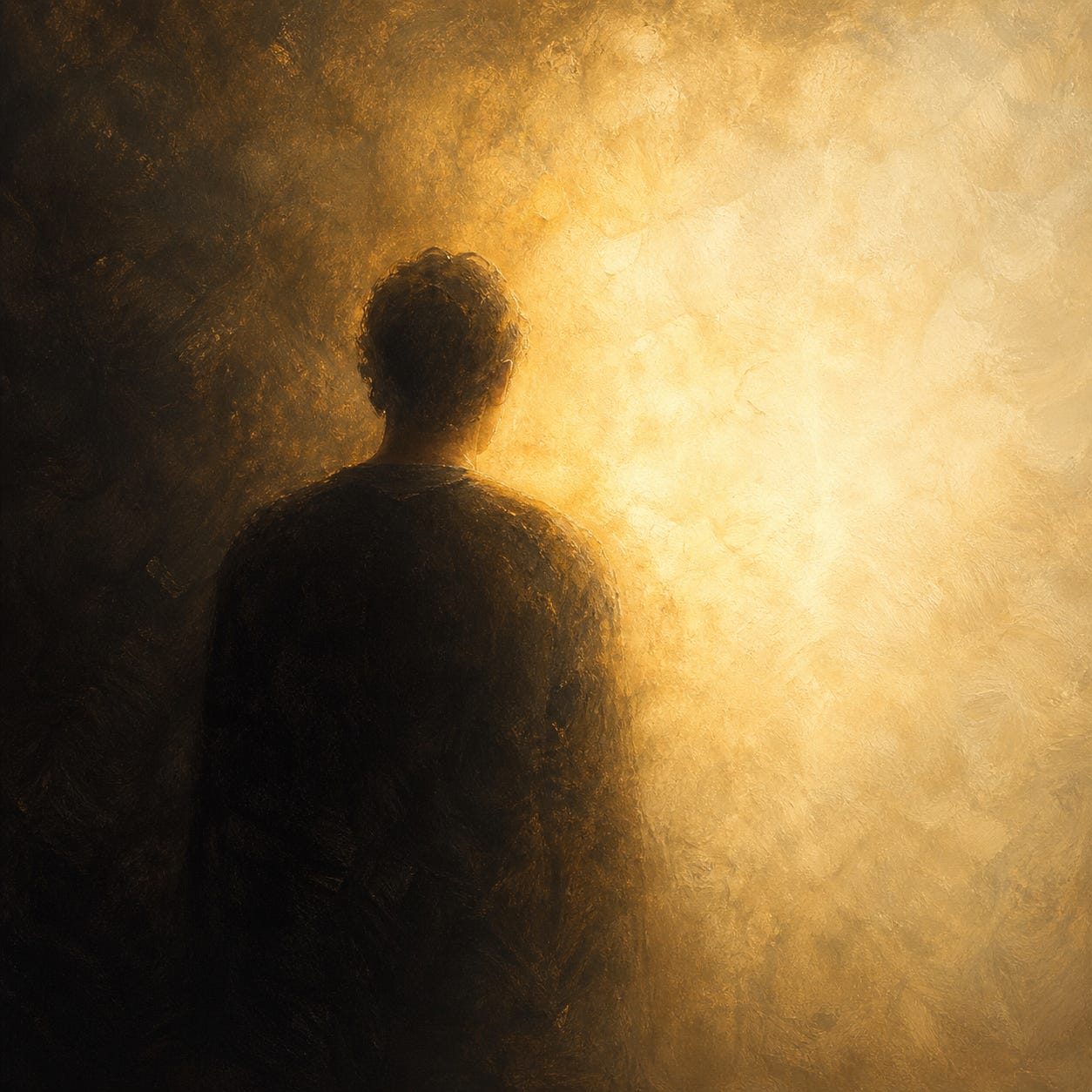
The Socratic image holds throughout, and now holds with more weight than before. The eye recognises itself in the place where the other eye is most fully eye — not in the catalogue of features the other eye presents, but in the living point where vision is alive in it. So too with souls, and so too with persons. We do not meet one another in the inventory of qualities we compare. We meet at the point where each participates in what makes them be the one they are, in the brightest signature of their own kind. And this point is reached not by looking harder, but by standing in the kind of relation that lets such a meeting take place at all. The light by which we see one another is, if the older account is right, never merely our own. It is borrowed, as everything is borrowed, from a higher source — and the recognition of the borrowing is itself the recognition of the persons. To know another, in the strong sense, is already to be in relation to what is above us both.
So too with persons.
Attention opens the door. Encounter enters the room. And what is found there is not simply further information, but the living reality that being exceeds every map drawn of it.
Threshold, not the depth.